It began with a story.
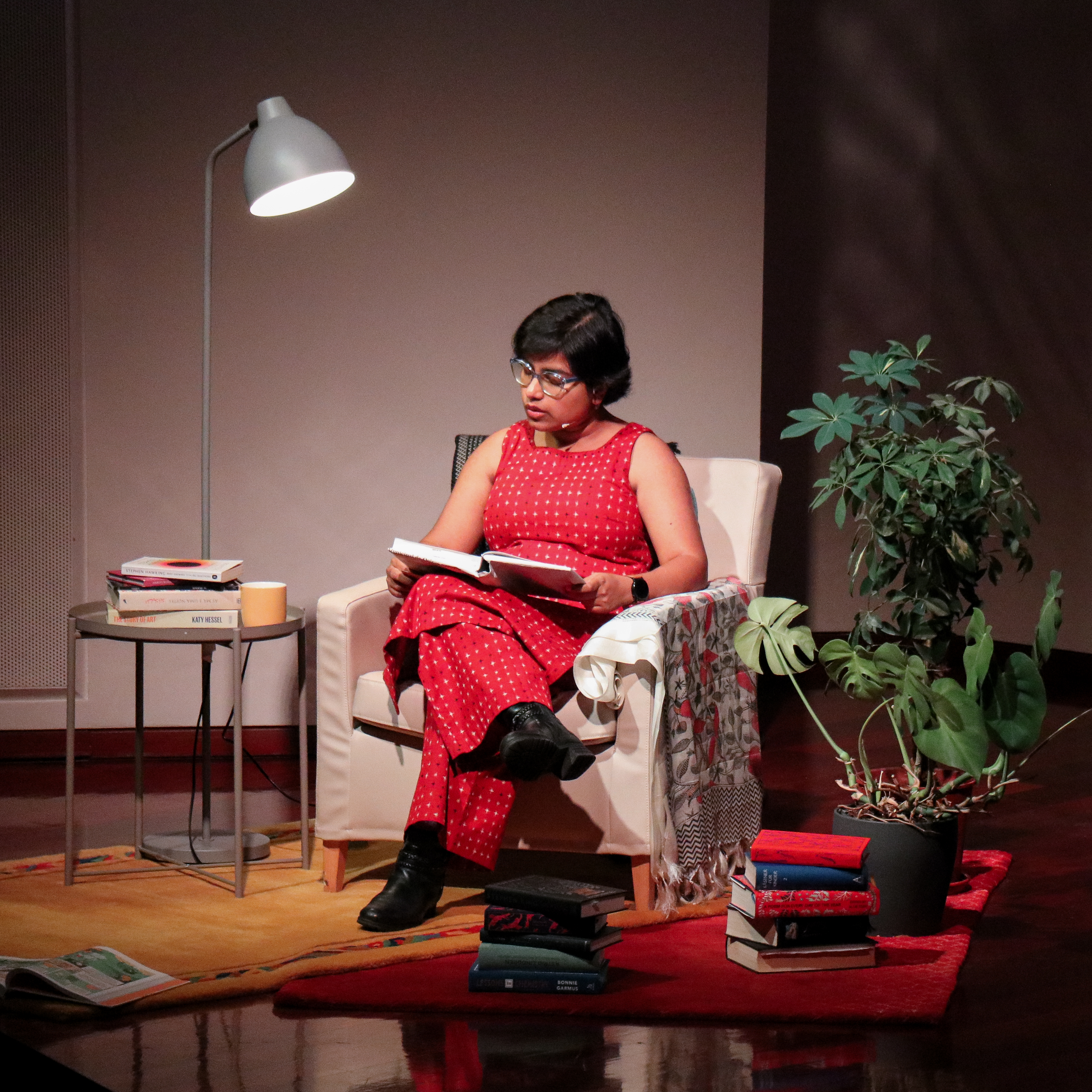
The auditorium was dark, except for a spot of light illuminating a corner of the stage where we could see a young woman in a red dress with a book in her hands, sitting in a red armchair beside a little table holding a mug and some books, a reading-lamp, and a stack of books lying on an orange carpet.
The storyteller was Saheli Roy, a PhD student in Neuroscience at the Champalimaud Foundation and one of the co-hosts for the evening. She read the beginning of an Indian story about kingdoms and pretenders to the throne.
The performance was more than an artistic opening. It was the evening's first demonstration of storytelling in action, inviting the audience to experience before analysing what stories do to our minds.
Her co-host, Lydia Fettweiss Neto – a colleague and a research technician, shared with the audience how she was shocked by the destruction of books portrayed in FroinçoisTruffaut's film “Fahrenheit 451”, and how this revealed to her just how powerful stories can be.
“Humans are storytelling animals”, she said. Speech doesn’t leave a fossil record, but we believe stories began orally, in folklore, and survived through retelling others, through collective memory and eventually through writing. They are not just the accounting of a series of events; they create shared meaning. “Constructing narratives about shared human concerns is important as it gives us an evolutionary advantage”, she added.
Fettweiss Neto’s introduction naturally grounded the evening's scientific perspective. If stories have accompanied humanity throughout evolution, what exactly do they do to our brains?
The first invited speaker of the evening was Buddhika Bellana, Associate Professor of Psychology at York University in Toronto. He joined the event online from Canada. “I’m a cognitive neuroscientist and this is an event about stories. Why am I here?”. His answer was simple: “stories are tools for scientists of the mind and brain because they shape our thoughts; they are a window into the workings of the mind”. Stories are how we use words to build worlds, making them a powerful tool for scientists who are interested in memory and imagination.
Bellana is interested in what he called the “momentum” of stories, that is, their capacity to “change who we are temporarily”. This is related to what he referred to as “book hangover”: being unable to immediately start a new reading after we finish a book, because our thoughts linger on the book we have just read.
To test this idea, Bellana's team asked participants to freely associate words before and after reading a story. Some read the original narrative, while others read scrambled versions in which either the sentences or the individual words had been rearranged. The question was simple: would a coherent story continue to influence people's thoughts even after they had finished reading? The answer was yes.“The strongest effect was associated with the immersive story”, Bellana explained. “The immersive story seemed to be able to shape our thoughts; it’s the coherent stories that persist”, he said.
And he concluded: “stories that can transport us into alternate worlds are not just useful for scientists of the mind and brain; they are an essential tool, because they are a vehicle for bringing this kind of phenomena into our sight”.
If Bellana showed that stories can temporarily shape the way we think, the next question was equally intriguing: why do some stories continue shaping human minds across generations while others disappear?
Just like living organisms, stories are always evolving, adapting to their environment, migrating, co-host Fettweiss Neto had pondered in her earlier intervention. In fact, we could even say that they are competing, as it were, for survival, through being retold from memory by people. So what makes them successful or unsuccessful in this competition to survive?
Joe Stubbersfield studies precisely this: why some stories are passed on for centuries while others fade away. In other words, he is interested in the cultural evolution of stories. A senior lecturer in Psychology at the University of Winchester in the UK, he was the second invited speaker (this time physically present).
One of the traits of a “sticky” story is that it fits cultural expectations, that it becomes more familiar. As an example, Stubbersfield gave the story of “Little Red Riding Hood”: in Europe, it features a bad wolf, while in Asia it involves a tiger. Sometimes the protagonist is not a girl, but a boy.
Another factor for “stickiness” is localisation. In other words, the closer to us – geographically speaking – the story is set, the more emotional impact it will have on us.
This is particularly true for scary narratives, as Stubbersfield illustrated with “The Tale of Bloody Mary”. Set in Lisbon, it is the story of a woman called Maria, who suffers such horrific facial disfiguration in a coach crash that she cuts her throat and throws herself from the Belém Tower. The legend goes that if you call her name three times in front of a mirror lit only by a candle, her ghost will appear reflected in the mirror and attack you.
This story – combining a mirror, a ghost, and a repeated phrase – exists in varied versions in different places: a witch of Salem in the US, Queen Mary in the UK, yet another in Brazil, explained Stubbersfield, and has been going around under different guises. The movie “Candyman” was inspired by the tale of Bloody Mary.
“It spread in the 19th century in greeting cards”, added Stubbersfield, about a mirror who revealed to girls the face of who they were going to marry (with the bad and scary outcomes we might imagine).
Yet another element that makes stories – and in particular scary ones – memorable is our “negativity bias”. “Negative content is much more successfully retained – and even more so if associated with threat”, Stubbersfield said. Humour may also work, but making people laugh might not be as easy as making them afraid.
So, what makes a story successful? “Cultural familiarity, emotional resonance, supernatural content (though not too much), and evoking negative emotions”, Stubbersfield concluded.
As the scientific discussions came to a close, Saheli Roy returned again to the story that weaved throughout the evening, revealing that it was adapted from the Mahabharata, one of the two major Sanskrit epics of ancient India. It was a fitting ending as her telling of the ancient tale brought the event's defining themes to life, from how stories shape thought and cultural identity to the role of supernatural powers and danger.
After spending nearly two hours exploring why stories shape memory, emotion and culture, the audience was reminded that sometimes the best way to understand the power of stories is simply to listen to one.
Text by Ana Gerschenfeld, Champalimaud Foundation’s Health&Science Writer