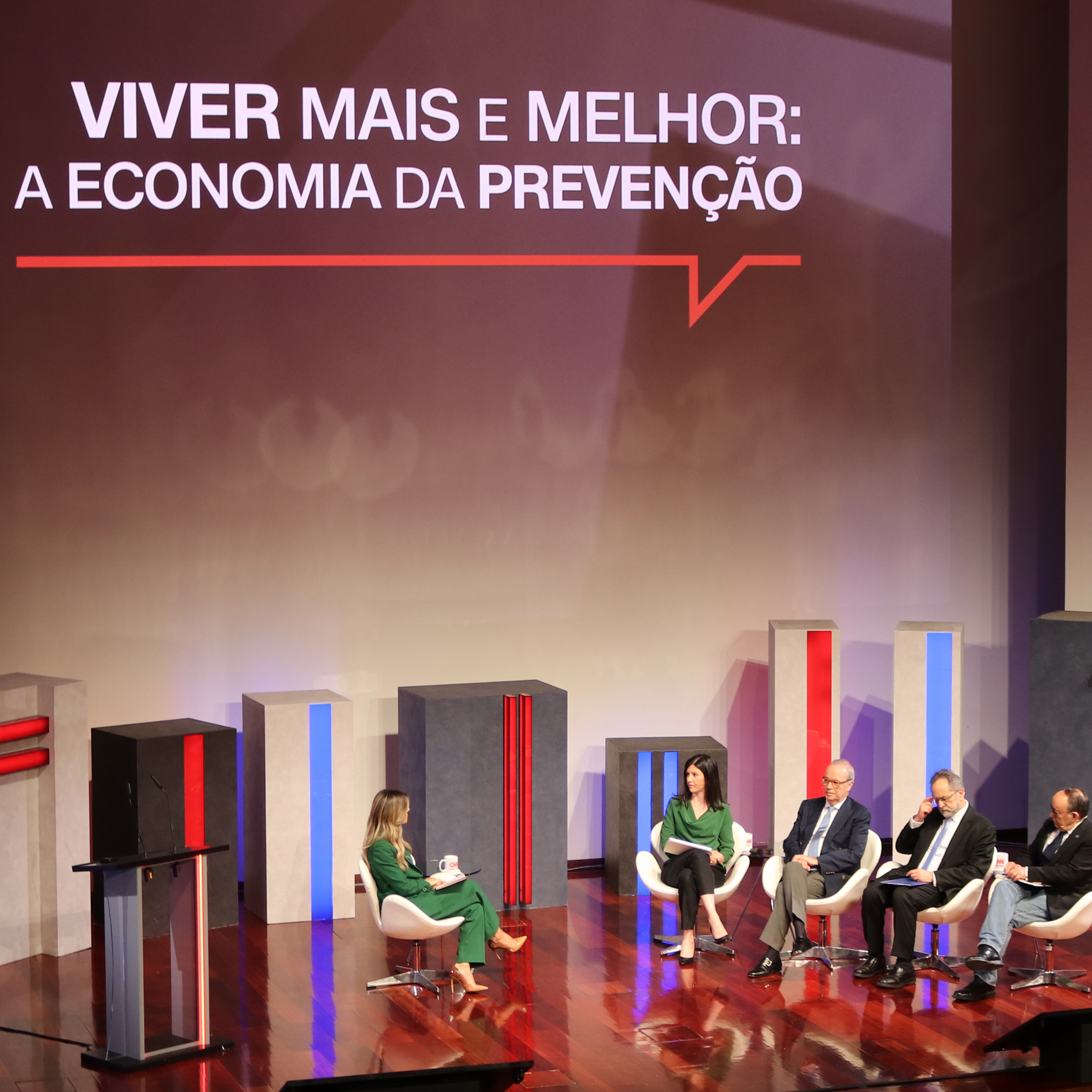
Under the central theme of efficiency as a condition for a more sustainable, equitable and future-ready healthcare system, the event established itself as a forum for discussing concrete solutions, with proposals for more efficient use of public investment, improved incentives for professionals and patient-centred policies.
In the opening session, the Minister of Health, Ana Paula Martins, stressed the urgency of structural reforms in the National Health Service (SNS), noting that the current emergency care model “is neither effective nor efficient” and that “Portugal has no more time to postpone transformation”.
Throughout the morning, various panels addressed topics such as the future of the SNS, management and efficiency in a universal healthcare system, healthcare financing, and the regulation and democratisation of science. Participants included guests such as former UK Secretary of State for Health Andrew Lansley, the President of Infarmed, Rui Santos Ivo, the Director-General of Health, Rita Sá Machado, and representatives from organisations such as Pfizer, the Portuguese Medical Association and ACSS.
The Champalimaud Foundation was represented by its President and Vice-President, Leonor Beleza and João Silveira Botelho, who took part in discussions on efficient investment in healthcare and the importance of prevention, reinforcing the institution’s mission to contribute to a more innovative, sustainable and people-centred healthcare system.
Investing efficiently in healthcare
In the round table “Investing efficiently in healthcare”, Leonor Beleza emphasised that the main challenge facing the system is not to increase spending indefinitely, but to ensure that every euro is used wisely and with real impact on people’s lives. “Our problem is not how much we spend, but whether we spend well on healthcare,” she noted, adding that there is limited room to increase the sector’s share of the State Budget.
Drawing attention to inequalities in access, Leonor Beleza pointed out that “unfortunately, healthcare today is a sector where there is no reasonable equality of access”, since only a minority of Portuguese citizens can choose between public and private care through health insurance. The discussion with Miguel Ginestal, Director-General of APIFARMA, and Pedro Pita Barros, Professor at NOVA University Lisbon, focused precisely on how to direct investment to reduce these asymmetries, strengthen the efficiency of the SNS and create conditions for innovation and equity to progress hand in hand.
Living longer and better: the economics of prevention
In panels dedicated to the theme “Living longer and better: the economics of prevention”, Andrea De Censi, Director of the Breast Department at the Champalimaud Foundation, and João Silveira Botelho advocated a shift in paradigm centred on prevention and early diagnosis. Andrea De Censi warned that Portugal is “50 years behind in prevention in oncology compared to cardiovascular medicine”.
From a public health perspective, José Manuel Boavida, President of APDP, stressed that “what most impacts health are chronic diseases” and that the most successful interventions are those that take place in the pre-disease phase. This view was reinforced by Rita Sá Machado, Director-General of Health, who stated that “80% of what impacts health does not depend on healthcare services”, highlighting that prevention and social and behavioural determinants should carry as much or more weight than treatment itself.
Prevention as public policy and incentive
During the round table on this topic, João Silveira Botelho argued that “there must be a comprehensive and public prevention programme”. He argued that prevention cannot rely solely on individual initiative or fragmented programmes, but should be structured as an integrated public policy, with clear targets and continuous monitoring.
João Silveira Botelho also proposed a model of positive incentives, whereby “people should be rewarded for prevention”, for example through tax benefits for those who comply with a defined preventive plan. If prevention leads to earlier diagnoses and less complex treatments, the system will be not only fairer, but also more efficient and sustainable in the medium and long term.
Text by Teresa Fernandes, Co-Coordinator of the Champalimaud Foundation Communication, Events & Outreach Team.