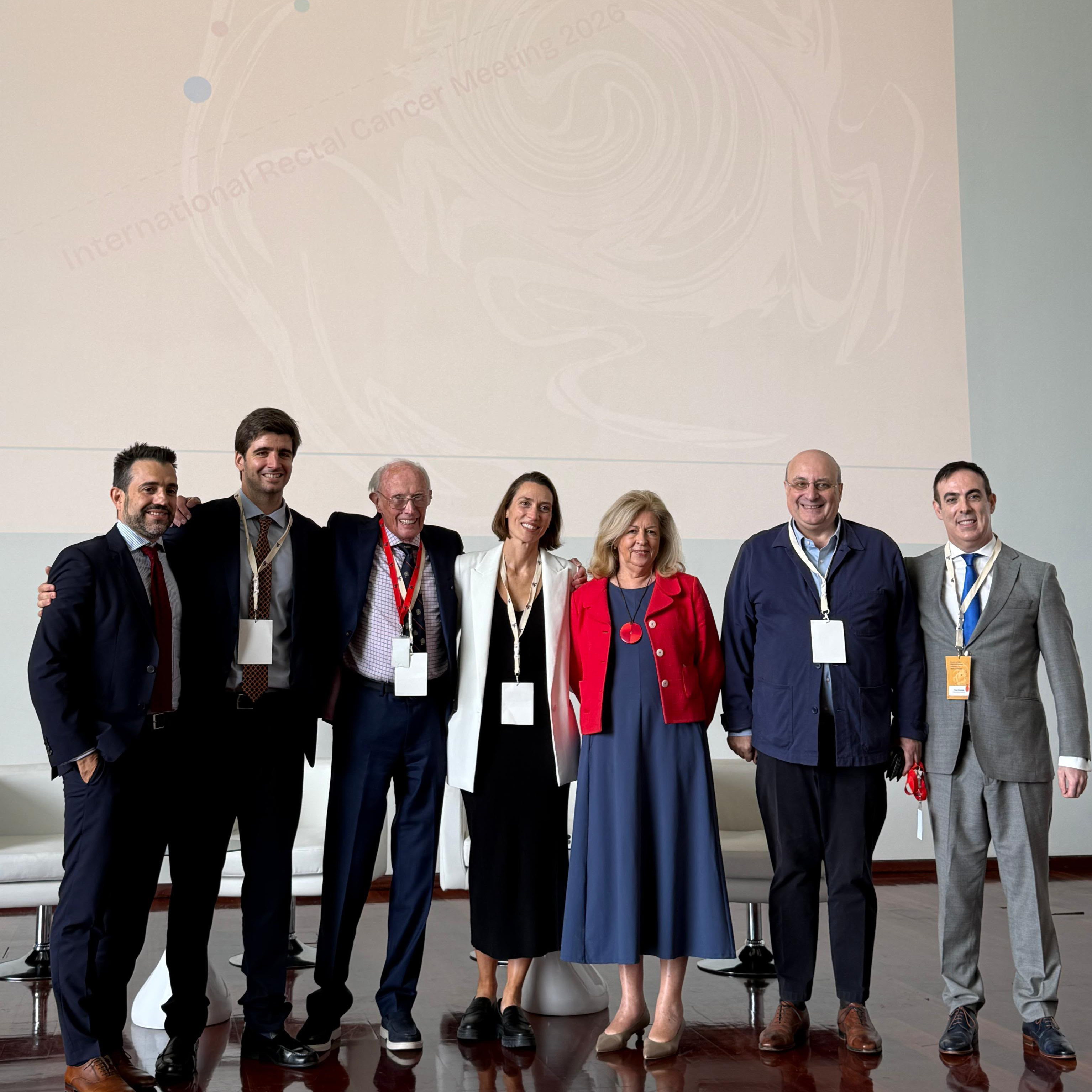
A legacy that changed rectal cancer
When Professor Heald first described TME, local recurrence rates after rectal cancer surgery in many centres were 20-30%, with devastating consequences for patients. By insisting on meticulous, sharp dissection in the “holy plane”, respecting embryology and removing the mesorectum as an intact package, he showed that local recurrence could be reduced to single digits, with corresponding gains in survival and function.
Opening the meeting, which happened on the 22nd and the 23rd of May, Professor Markus Büchler, Director of the Botton-Champalimaud Pancreatic Cancer Conference, reminded the audience just how radical that shift was. “It is now 50 years since Bill invented and created the operation we know as Total Mesorectal Excision. This is such a success story that I would compare it to the first heart or liver transplant: a pivotal surgical breakthrough that everyone followed, because it was so convincing, so clear, and so good for patients,” he said. “In the 1980s and 1990s, our department in Germany had a 30% local recurrence rate; every third patient developed a local recurrence and half of them later died from it. Then, suddenly, an article in The Lancet showed that this operation could be done with a local recurrence rate of 4%. First, we could not believe it; nobody believed it. The second reaction was: we have to see this man and see him doing this operation. I went to Basingstoke, watched Bill perform two TMEs in two days, and I went home and never did anything else than that for rectal cancer for the rest of my life.” To this he later added, “when the principles of TME were extended to colon, pancreatic and oesophagogastric surgery, the impact spread far beyond rectal cancer, saving not just hundreds of thousands but perhaps millions of lives over time”.
As Leonor Beleza, President of the Champalimaud Foundation, underlined, this was not just a technical refinement but a cultural shift: “It is impossible to speak about the modern history of rectal cancer without recognising the extraordinary contribution of our friend and colleague Bill Heald… his pioneering work on total mesorectal excision transformed rectal cancer surgery internationally and changed outcomes for countless patients around the world.” For the Champalimaud colorectal programme, she noted, his influence has been “one of generosity, intellectual leadership, and shared ambition”, helping to shape not only operative techniques but also the culture of the unit.
Science built on anatomy and collaboration
Throughout the meeting, speakers emphasised the core principles that underpin TME: precise anatomy, disciplined technique and relentless audit, and explored how those principles now extend to molecular biology, imaging, minimally invasive surgery and systemic therapy.
Radiologist Professor Gina Brown retraced the journey from the era when the digital rectal examination was the primary staging tool to today’s high‑resolution MRI and refined risk stratification. Working hand‑in‑hand with pathologists and surgeons showed how features such as mesorectal fascia involvement, extramural venous invasion and tumour deposits can and should guide decisions about neoadjuvant therapy and organ preservation, rather than lymph node size alone. “We are not here to help TME justify itself,” she argued. “We are here to improve prognostic staging of patients… what does a scan mean for survival, and what does it mean for the patient?”
Surgeons such as Professor Amjad Parvaiz contextualised TME within the evolution of technique, from open surgery to laparoscopy and robotics, while insisting that technology remains “a tool, not a religion”. Robotics and advanced imaging can help to reproduce Bill’s operation consistently in difficult male, obese or previously irradiated pelvises, they argued, but the “true religion” of the surgeon remains unchanged: “New interventions are merely the tools; the religion for the surgeon is anatomy.”
Other sessions explored lateral pelvic node dissection, pelvic exenteration, the balance between surgery and non‑operative management, and the role of total neoadjuvant therapy, always returning to the question Bill himself has long posed: how do we balance local control, survival and function, avoiding both overtreatment and undertreatment for each patient?
A "love story" with the Champalimaud Foundation
For the Champalimaud Foundation, the meeting was also a celebration of a long‑standing, almost personal relationship with Professor Heald. Vice‑President Dr João Silveira Botelho described it “in a nutshell” as “a love story at first sight”: “The Foundation at that time was still wearing short pants… Bill came when we didn’t even have surgery here. He believed not only in the institution but in the dream. More than confidence in the institution, he was confident in the dream – and that has been one of our most important achievements.”
That dream included building a colorectal programme that could innovate while remaining patient‑centred, from the adoption of TME and lateral node dissection to the development of the “watch and wait” strategy for selected patients with complete clinical response after chemoradiation or total neoadjuvant therapy. An approach pioneered in collaboration with international partners and now supported by long‑term data on local regrowth. Many speakers from Lisbon and abroad underlined how Bill’s visits, mentoring and quiet insistence on standards helped to shape that journey, recruiting and inspiring surgeons who now lead robotic, organ‑preserving and extended resections worldwide.
The man behind the method
Beyond the numbers and the technique, some of the most memorable moments of the meeting were those that captured Bill Heald the person: surgeon, teacher, innovator, sailor, mentor, father and friend. A surprise tribute video, prepared by colleagues, friends and family, reminded the audience that his legacy is written not only in survival curves and certification programmes but in the lives and careers he helped shape.
Colleagues from the UK, Europe, Asia and the Americas spoke of a “living legend” whose curiosity, exactness, courage and humility set the tone for a generation of colorectal surgeons.
From the holy plane to the unknown
In his own remarks, Professor Heald returned to the theme of the “Centre for the Unknown”: the idea, at the heart of the Champalimaud Foundation, that science and clinical care must constantly face uncertainty, about biology, about the right balance between surgery, radiotherapy, chemotherapy and immunotherapy, and about when not to operate. He acknowledged the courage of colleagues who have taken TME’s anatomical insights and used them not only to improve surgery but, in selected cases, to justify the absence of surgery.
Speakers emphasised that future progress will depend on exactly this integration between anatomy and biology, structure and science: using MRI, molecular subtyping, immunology, circulating tumour DNA and emerging AI tools not to replace judgement but to refine it, so that “the right patient gets the right treatment, sometimes more, sometimes less”.
Fifty years after TME was first described, its principles - understand the anatomy, respect the planes, operate with precision, teach with generosity, and never forget that behind every specimen is a patient - remain the foundation on which new techniques and new therapies are built.
And through the many surgeons, clinicians and scientists he taught, inspired and challenged, Professor Bill Heald’s legacy will continue to shape rectal cancer care for decades to come.
Text by Teresa Fernandes, Co-Coodinator of the Champalimaud Foundation's Communication, Events & Outreach Team