Could radiotherapy become the standard for lung cancer treatment? Could Artificial Intelligence (AI) help oncologists in treatment selection? Should many more resources be devoted to prevention, namely populational screening for this cancer?
Cancer experts gathered at the Champalimaud Foundation (CF), in Lisbon, for the third edition of the Lung Cancer Fight Club, to debate for a day on these and other issues.
Nuno Gil, leader of the Lung Unit at the CF, framed the meeting around the future of lung cancer care, stressing that global cancer mortality reductions are largely driven by decreasing lung cancer deaths, yet lung cancer remains the leading cause of cancer mortality worldwide.
Lung cancer is fourth in incidence (number of new cases per year) but first in mortality in Portugal as well as Europe. Today, the standard treatment for early lung cancer is surgery – when the cancer is operable. The great majority – more than 80% – of lung cancers are the so-called “non-small cell” lung cancers (NSCLC) and are usually treated with surgery in their early stages.
The first speaker of the conference – Santiago Figueroa, a thoracic surgeon from the Clinical University Hospital of Valencia in Spain – explained that only about 20% of NSCLC patients actually undergo surgery, and about half of operated patients relapse. This means that only some 10% of all NSCLC patients become disease‑free surgical survivors. But given that most long‑term survivors are surgical patients, surgery remains the main curative modality.
Overall survival is improving, especially in stage IV, he said, due to targeted therapy and immunotherapy. Nonetheless, Figueroa stressed that, to improve outcomes, increasing the proportion of patients eligible for surgery is paramount and can only happen via early diagnosis of the disease.
The following speaker countered that perhaps radiotherapy could become the gold standard in the future. Drew Moghanaki, a radiation oncologist from the University of California, argued for Stereotectic Body Radiotherapy (SBRT) as a possible substitute for surgery in early stage lung cancer.
The fact is that surgery can lead to severe complications. Also, he stressed, surveys of those who have had both treatments report easier recovery, less stress and greater satisfaction with SBRT.
An analysis of the National Cancer Database, added Moghanaki, shows a decline to 40% in the proportion of stage I patients in the US undergoing surgery, and a corresponding rise in SBRT use, even in the absence of definitive clinical trials. He also noted that the data available suggest that there is no clear survival advantage of using surgery over using SBRT.
Surgery remains indispensable, he concluded, especially for larger or centrally located tumours and when it is critical to remove lymph nodes, but SBRT appears comparable to surgery in selected stage I patients and is expanding, driven by patient preference, safety and emerging data.
During the discussion that ensued, however, all agreed that lung cancer screening and early detection will save far more lives than marginal differences between treatment techniques.
Prevention was the topic of Andrea De Censi’s talk. De Censi was recently appointed head of CF’s Breast Cancer Department, and he advocates shifting resources from treatment to prevention. Nearly 70% of screening-detected lung cancers are stage I, the most manageable ones. Also, he noted, two trials (one performed in the US and the other in the Netherlands and Belgium) showed a 20% to 30% mortality reduction from lung cancer thanks to low-dose CT screening. Unfortunately, he concluded, screening implementation at the populational level remains slow in a number of countries, including Portugal.
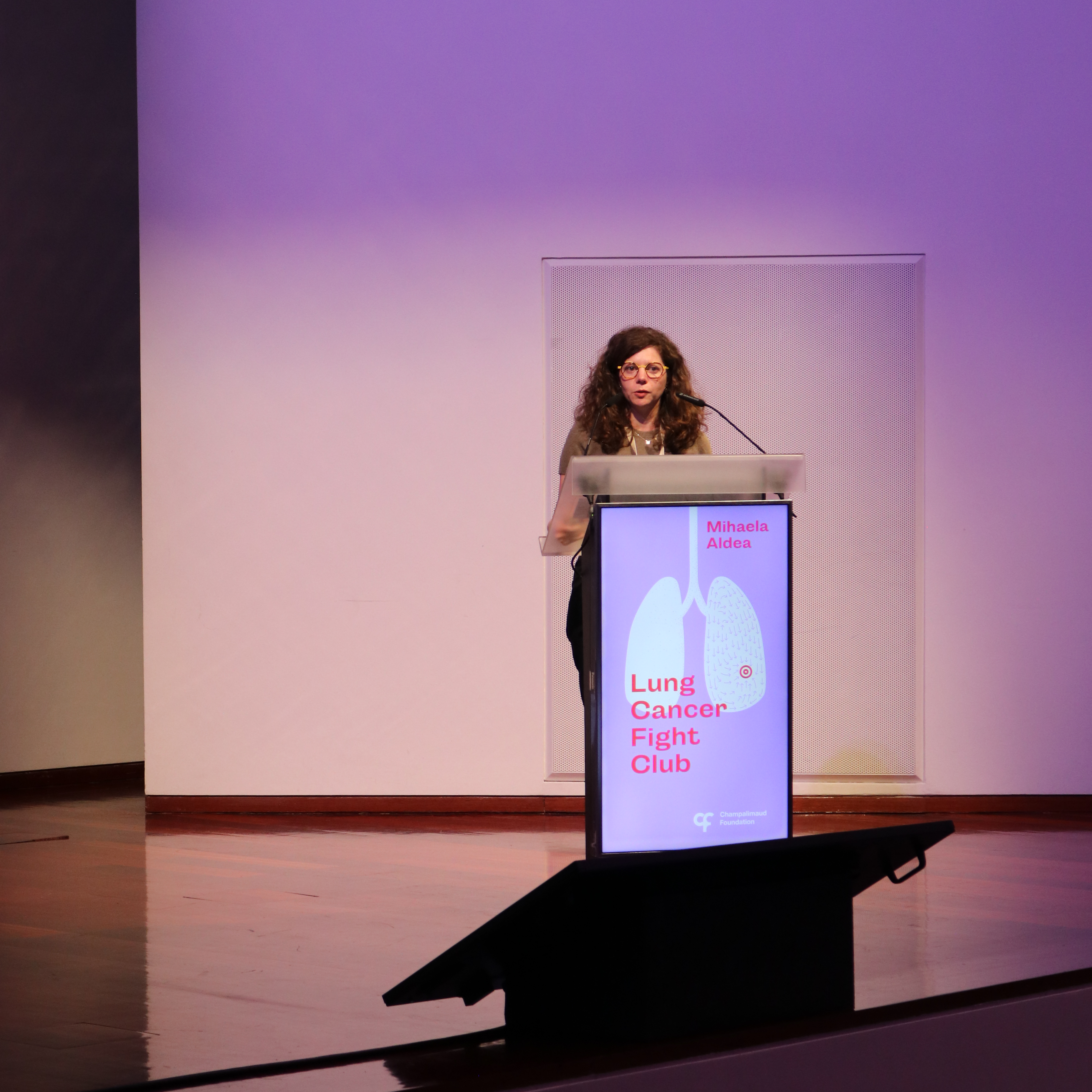
The potential for AI use in lung cancer was broached in a talk by Mihaela Aldea, from the Gustave Roussy Institute near Paris, France. According to her, one of the major limitations to applying AI for assessing pathology, predicting the presence of mutations, or aiding treatment choice, is that 40% of FDA-approved AI devices lack clinical validation. Other important limitations are the lack of accountability for false predictions and of data fairness for minorities.
And so we come to another hurdle, highlighted repeatedly throughout the day: the lack of robust clinical trials – to validate AI tools, but also SBRT or the use of robotic surgery for lung cancer diagnosis and treatment.
In her talk, Inês Pires da Silva, from CF’s Dermatology Unit, called for a “revolution in clinical trials”. Clinical trial infrastructure remains slow and bureaucratic, she argued: less than 5% of cancer patients enroll in trials and 40% of trials fail to complete recruitment.
Pires da Silva, a worldwide recognized melanoma researcher, proposed three pillars of reform: smart, seamless design of the trials, smart access (decentralised trials using tools such as e-consenting and virtual visits, broader eligibility criteria and measures to address linguistic/cultural barriers and territorial equity), and smart decisions (for instance, using AI-derived biomarkers and digital pathology – that is, converting glass histology slides into high-resolution digital images that can be viewed, analysed and stored on a computer rather than seen only under a microscope).
Also of note was the talk by Tony Mok, from the Chinese University of Hong Kong, introduced by the session’s moderator, Cláudia Matos from the CF, as “a global leader in thoracic oncology whose groundbreaking work in precision medicine has changed the way we treat our patients”.
Tony Mok's main message was that a “cure” in lung cancer is not a binary yes or no issue, but a concept closer to “caring for” patients throughout their life – a notion that does not exclude lifelong treatment. In this sense, he said, we are curing a meaningful number of patients today. But there are limitations, he argued, namely the development of resistance to the long-term use of current treatments. To avoid this, future directions in research lie in new generations of drugs, personalised cancer vaccines and cell therapies.
Mok also called for the end of political barriers that prevent effective, cheaper drugs, particularly those made in China, from reaching patients all over the world.
Other, more general subjects were also dealt with all during the day, such as the relevance of the microbiome in cancer and the importance of integrating nutrition and physical exercise in cancer care in general.
For lung cancer in particular, the main take-home message? To find the means to diagnose it as early as possible and try to pave the way to a cure through studies and meetings like this one, involving the scientific community at large.
Text by Ana Gerschenfeld, Health&Science Writer of the Champalimaud Foundation.