
29 April 2026
Marcelo Mendonça
From curiosity to care: shaping the future of neurotherapeutics
29 April 2026
From curiosity to care: shaping the future of neurotherapeutics
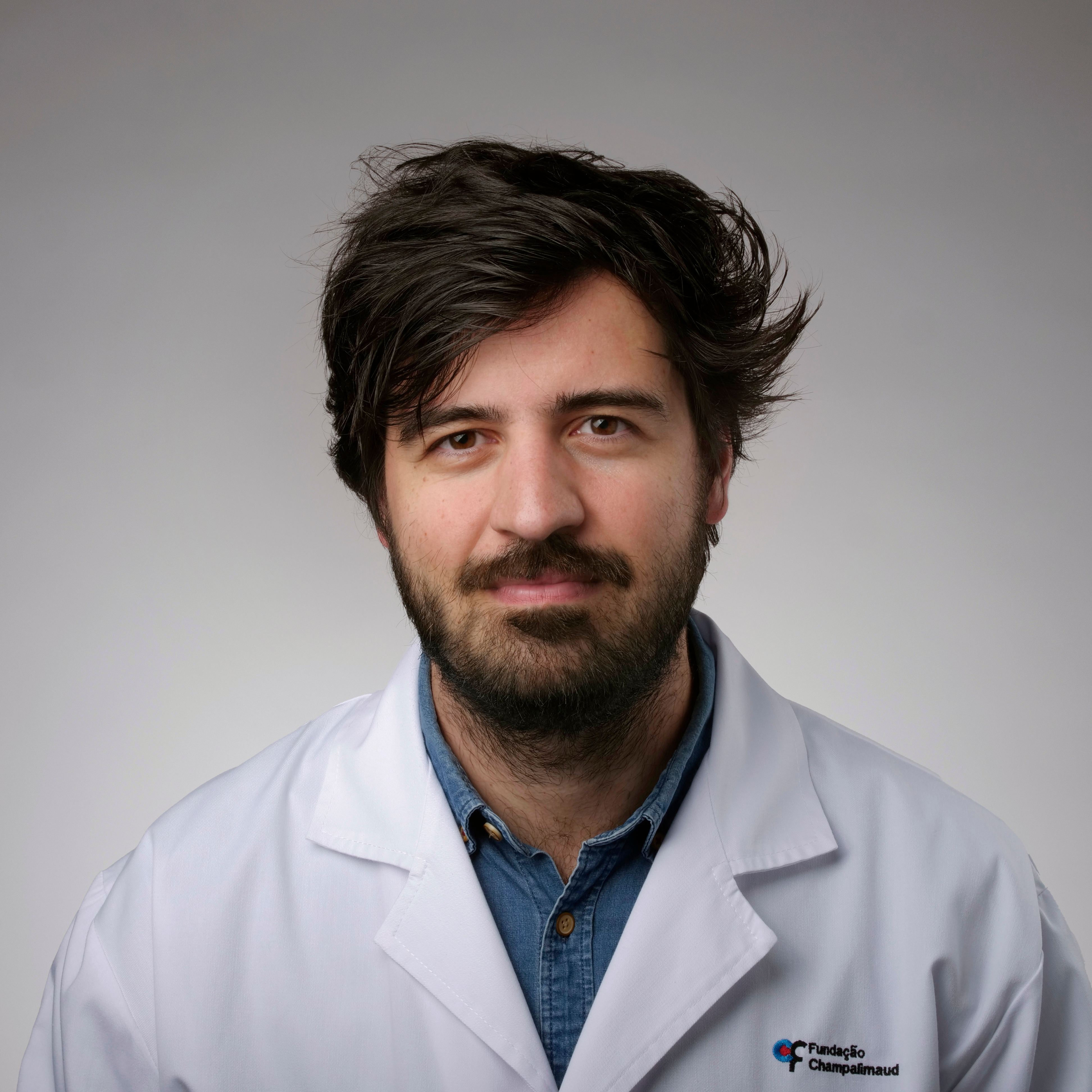
Driven by a fascination for science, behaviour and biology – and shaped by his social environment – Marcelo Mendonça’s path to medicine stems from curiosity and was galvanized by a single, transformative clinical moment.
Marcelo Mendonça is currently an Assistant Professor of Neuroscience at NOVA Medical School and an Assistant Professor of Clinical Research at Universidade do Algarve. He also serves as a neurologist at the Champalimaud Foundation, where he works within the Neuropsychiatry Unit and is Group Leader in the Neuroscience of Disease Programme, where he is establishing his own laboratory. In addition, he holds the role of Vice-President of the Portuguese Neurology Society. Most recently, together with Albino J. Oliveira-Maia, he has opened a new chapter with the Digital Neurotherapeutics Centre (DNTx Centre), a centre designed to integrate neuroscience, technology, and patient-centred care.
In this conversation, Marcelo reflects on his journey, from early pharmacology lectures to pioneering behavioural neuromodulatory interventions for Parkinson's disease, and the boundless opportunities now unfolding in neurotherapeutics.
I have always looked for challenge and excitement in what I do, and once something no longer provides that, I would look for the next adventure. I grew up in a rural, non-academic setting in northern Portugal. Still, I was constantly drawn to mathematics and astronomy, and I insisted that my parents take me to every Ciência Viva exhibition in Porto – which fortunately for me, they did.
I grew up at a time when there was a strong establishment of the “social escalator”. If you were a good student, there was an expectation, almost a bias, that medicine was the right path. I liked biology and behaviour, but I wasn’t immediately convinced. I went to medical school somewhat unsure, but open.
During medical school, my interest in brain function gradually grew, particularly for motor dysfunctions. But I vividly remember struggling through pharmacology classes, trying to make sense of the “go/no-go” model of the basal ganglia. It just didn’t seem to explain the complexity of animal movement. Then, in 2007 during a neurology rotation, I witnessed an extraordinary scene that unlocked something in me: a patient with severe tremor who stopped shaking almost instantly after activation of a deep brain stimulation (DBS) device. It felt almost magical! That moment changed everything – I knew I wanted to dig deeper into the neuroscience behind it.
Deep brain stimulation (DBS) is a true game-changer, a field where I have worked extensively. For example, we did trials that used accelerometers to characterise gait phenotypes in patients undergoing DBS, generating high-quality data to refine interventions and raise standards of care. More recently we have been refining data acquisition using markerless motion capture.
In the Neuropsychiatry Unit, I have also developed interests in non-invasive brain stimulation techniques such as transcranial magnetic stimulation (TMS). Although born from the clinical neurophysiology environment, the main impact of TMS has been to transform psychiatric care. The interest in non-invasive brain stimulation in Neurology has been increasing in the last few years. For instance, Giacomo Koch’s trial demonstrated that, in Alzheimer’s Disease, EEG-informed TMS could have an impact on symptoms, with promising effect sizes when compared to more traditional pharmacological treatments.
What excites me most is the possibility of combining neuromodulation with behavioural interventions. In Parkinson’s disease, for example, pairing brain stimulation with physical activity may lead to better outcomes with fewer side effects. Indeed, I have been more interested in gait dysfunction, particularly freezing of gait, which remains one of the most challenging symptoms to treat. We’re preparing a clinical trial to test motor cortex stimulation in Parkinson’s patients, using insights from brain lesion studies and detailed behavioural assessment to refine targets. Ultimately, the goal is to deliver personalized interventions that bring together brain stimulation and behavioural therapies.
The COVID-19 pandemic exposed significant gaps in care for patients. Amongst the affected patients, many suffering with chronic neurological conditions struggled with access to treatment, continuity of care, and rehabilitation. It became clear that we needed new approaches. Digital therapeutics offer a way forward – through non-invasive brain stimulation, wearable technologies, and immersive behavioural interventions.
The DNTx Centre is the first of its kind, designed to integrate these tools into clinical care from the ground up, rather than treating them as add-ons. Our focus will be on disorders affecting movement, cognition, and neurodegenerative diseases. For example, we are developing and testing gamified rehabilitation tools to determine whether they can increase engagement, improve treatment efficacy, and translate that engagement into more meaningful real-world benefits.
We want this centre to function as a clinical validation space, a testbed for startups and emerging neurotechnologies, including those coming from initiatives such as the Neurotechnology Warehouse. We’re particularly interested in partnerships with groups developing AI tools, wearables, and digital therapeutic platforms that align with our clinical values.
As we move forward, I hope this centre will contribute to setting standards for safety, efficacy, and regulation in digital neurotherapeutics. Neurology is evolving, and we need to move beyond a purely pharmacological model. The brain cannot be looked at with the same perspective as the liver or the kidney; beyond processing information it produces complex behaviour and generates movements that are dynamic, adaptive and context-dependent. Our treatments should reflect this uniqueness.
Technology should enhance care, never replace human connection. Digital tools must empower clinicians as well as patients. Gamification, for instance, can make rehabilitation more motivating, while continuous data collection allows us to tailor treatments to the individual needs. At the end of the day, our aim is simple: improve patient's quality of life. Whether that means better symptom management, fewer side effects, or a more personalized care, technology is only valuable if it serves the people that need care.
I envision a future where non-pharmacological interventions are standard of care – just as mainstream as medications. We’re already seeing this shift in conditions like Tourette’s syndrome and Parkinson’s disease through behavioural therapies. By combining these approaches with advanced technologies, we can create more effective, patient-centered models of care.
This DNTx Centre is only the beginning. In five years, I hope we’ll have contributed meaningfully to a transformation in how neurological disorders are treated, that is grounded in innovation, collaboration, and, above all, patient well-being.
