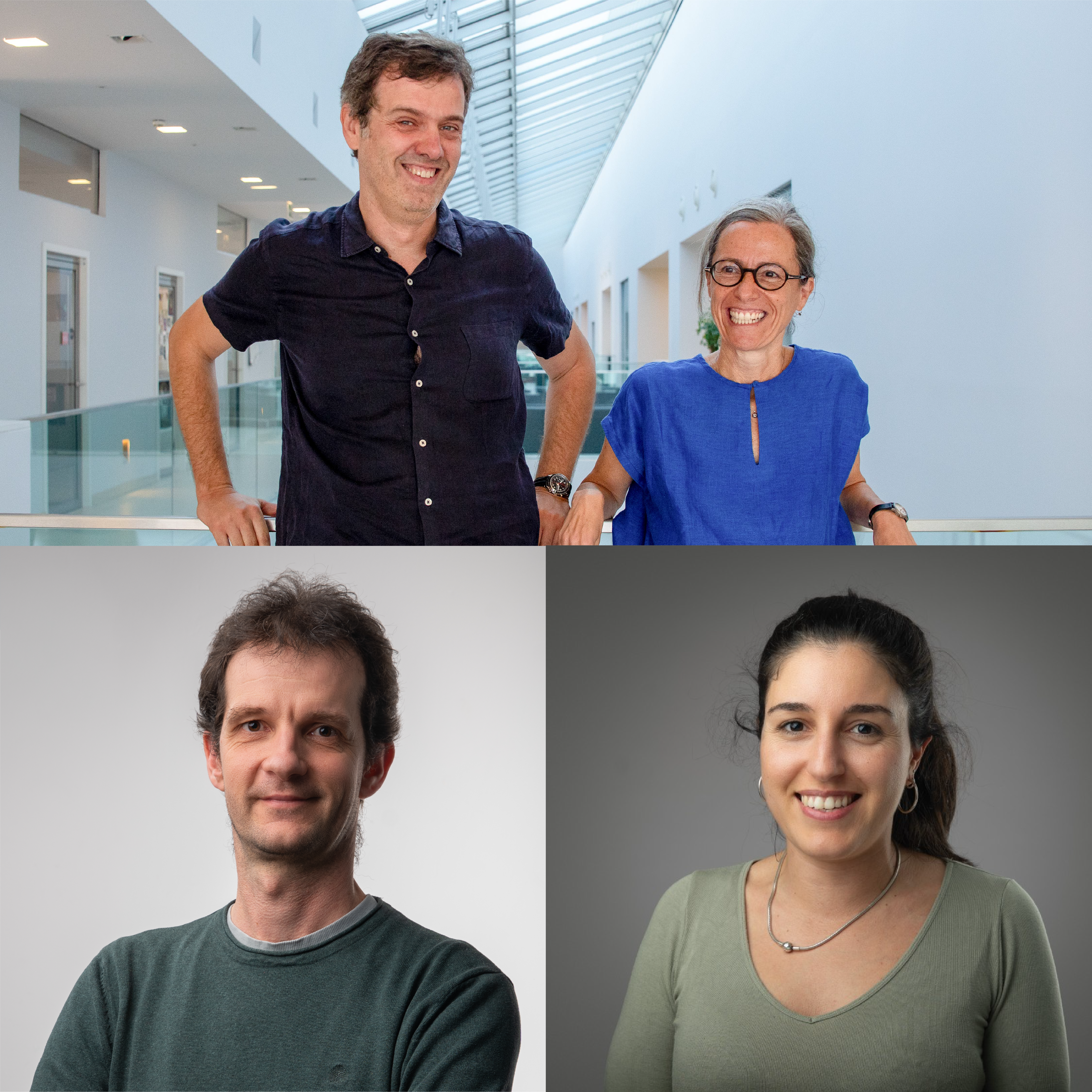
The three projects span very different areas of research. Moita, working in partnership with César Mendes at NOVA Medical School, will investigate how the brain and body produce the rapid defensive reactions that make us jump or flinch when startled. Van Gisbergen will study how certain immune cells establish themselves in the lungs, with the long-term goal of improving vaccines against influenza and other respiratory viruses. Silva will test whether walking, rather than standing still, can make a well-established learning task more reliable as a way of assessing brain function, particularly that of the cerebellum, a brain region important for movement and learning.
Together, the awards underscore the “la Caixa” Foundation’s ongoing commitment to supporting excellent research with the potential to advance our understanding of health and disease and ultimately benefit public health.
Marta Moita: understanding what happens when we startle
When startled by a loud noise or a sudden movement, we instinctively jump or flinch. This “startle response” is an ancient survival mechanism shared across the animal kingdom, and when it becomes exaggerated, it is closely linked to anxiety disorders and post-traumatic stress disorder in humans. Despite how common and clinically relevant startle responses are, the factors that shape the brain circuits that produce them are still not well understood.
With €670,550 in funding to CF as part of a three-year consortium project worth €997,250, Moita’s team will use fruit flies – whose defensive behaviours resemble our own, but whose neural circuits can be studied and manipulated in far greater detail – to build a detailed picture of how startle responses are organised in the brain and body. The researchers will measure limb movements and changes in heart and muscle activity, and identify the specific neuronal circuits controlling different responses, from the senses that detect danger to the muscles that respond to it. They will also examine why some flies startle more than others based on their genes or past experiences.
The project is led by CF in partnership with Mendes, a neurogenetics researcher at NOVA Medical School, who brings expertise in motor control and sophisticated methods for analysing movement in fruit flies. His team will help resolve extremely rapid and complex movements involved in startle in fine detail. The collaboration builds on previous work between Moita and Mendes studying how muscles and movement contribute to defensive behaviours.
"By studying how startle works in fruit flies, we can gain insights into how the brain and body react to threats and the mechanisms by which our genes and experience contribute to it. This knowledge may help us better understand the pathologically exaggerated startle responses in anxiety and stress-related disorders", says Moita.
Bio: Moita has researched defensive behaviours throughout her career, from her PhD with Joseph LeDoux at New York University, where she used auditory fear conditioning to study memory formation, to her postdoctoral work with Anthony Zador at Cold Spring Harbor Laboratory, where she developed experimental approaches to study auditory perceptual decision-making. She later established her own laboratory at CF, where she explores how social context and the body's physiological state shape defensive behaviours, initially using rodents and later fruit flies. She recently completed a medical degree, deepening her research interests in brain-body interactions in health and disease states.
Klaas van Gisbergen: learning how immune cells make the lungs their home
Vaccination is an important means of protection against respiratory viruses. Vaccines prepare the immune system for future infections by exposing it to a weakened, harmless form of a pathogen, allowing immune cells to “remember” it and respond faster and more strongly the next time. Among these are T cells, some of which can remain in tissues after an infection or vaccination and help mount a rapid response when a pathogen returns. For respiratory viruses such as flu, however, current vaccines are not very good at recruiting these protective T cells into the lungs, where they are needed most.
With €499,950 over three years, van Gisbergen’s team aims to understand exactly how T cells develop once they reach the lungs, so that future vaccines can be designed to recruit them there more effectively. The researchers will track the fate of individual T cells over time – a technique known as lineage tracing – and combine this with an analysis of which genes each cell switches on or off as it matures, called transcriptional profiling. Together, these approaches will reveal the different developmental routes that T cells can take as they adapt to life in the lungs, and identify the signals that steer them down one path or another.
"The lungs provide a particularly challenging environment for the long-term survival of T cells, meaning that the cells must make unique adaptations to persist there", says van Gisbergen. "By identifying the signals that guide these cells, we want to know how T cells make the choices that allow them to adapt to the lung environment – knowledge that could ultimately help us develop vaccination strategies that steer them towards becoming long-lasting lung T cells”.
Bio: Klaas van Gisbergen completed his PhD at the VU University Medical Center in Amsterdam, under the supervision of Yvette van Kooyk and Theo Geijtenbeek, before carrying out postdoctoral research with Rene van Lier at the Academic Medical Center in Amsterdam and with Axel Kallies at the Walter and Eliza Hall Institute of Medical Research in Melbourne, Australia. He returned to Amsterdam to establish his own group at Sanquin Research, focusing on how T cells protect against viral infection. In 2023, he established the Tissue Immunity Lab at CF, where he studies T cell differentiation in the contexts of infection and cancer.
Tatiana Silva: can walking make a test of brain learning more reliable?
Imagine seeing a light that is repeatedly followed by a gentle puff of air towards the eye. Eventually, the brain learns the association and causes you to blink when you see the light, even before the puff arrives. This simple test of learning, known as eyeblink conditioning, has long been used to study how the brain learns, forms memories and adapts.
Eyeblink conditioning depends on the cerebellum, a region at the back of the brain that plays an important role in coordinating movement and learning. The task can detect changes associated with brain injury and neurological and mental health conditions, but clinical adoption has remained limited in part because responses can vary considerably both between people and within the same person.
Silva, postdoctoral researcher at CF, has received €80,000 through the inaugural “la Caixa” Foundation HealthCare Research call to investigate a deceptively simple way of making the test more consistent: walking. Research in animals shows that performing the task while moving can make learned responses more reliable. Silva’s project will test whether this also holds true in people, by asking healthy adults to perform the eyeblink conditioning task either stationary or while walking on a treadmill. If moving makes the test more reliable, this simple change could help establish eyeblink conditioning as a practical, non-invasive tool for assessing and monitoring cerebellar function, laying the groundwork for clinical applications.
“This funding will allow me to take an important step from fundamental neuroscience to human research”, says Silva. “My work in mice showed that whether an animal is moving or still can strongly influence cerebellar learning. With this project, I will test whether we can harness this finding to make eyeblink conditioning a more reliable measure of brain function in humans. For me, this grant is also an important step towards scientific independence, allowing me to build on my previous discoveries and establish a new research programme”.
Bio: Silva’s research focuses on how the brain learns and remembers, with a particular interest in the cerebellum and in how behavioural states such as locomotion influence learning. During her PhD in Megan Carey's laboratory at CF, she studied the neural mechanisms of cerebellar learning and memory in mice. She is now translating these discoveries into human research, also working with Marcelo Mendonça at CF to develop simple, non-invasive approaches to assess brain function, with the goal of informing clinical applications. In addition, she is an invited assistant professor at NOVA Medical School in Lisbon, and actively involved in mentoring, science outreach, and advocacy for equality, diversity and inclusion in academia.
Text by Hedi Young, Science Writer and Content Developer of the Champalimaud Foundation's Communication, Events & Outreach Team